
Making Excuses for Russiagate
As months turn into nearly two years and no solid evidence emerges to nail Russia for nabbing Election 2016, some big Russia-gate cheerleaders are starting to cover their tracks, as Daniel Lazare explains.
By Daniel Lazare
 The best evidence that Russia-gate is sinking beneath the waves is the way those pushing the pseudo-scandal are now busily covering their tracks. The Guardian complains that “as the inquiry has expanded and dominated the news agenda over the last year, the real issues of people’s lives are in danger of being drowned out by obsessive cable television coverage of the Russia investigation” – as ifThe Guardian’s own coverage hasn’t been every bit as obsessive as anything CNN has come up with.
The Washington Post, second to none when it comes to painting Putin as a real-life Lord Voldemort, now says that Special counsel Robert Mueller “faces a particular challenge maintaining the confidence of the citizenry” as his investigation enters its second year – although it’s sticking to its guns that the problem is not the inquiry itself, but “the regular attacks he faces from President Trump, who has decried the probe as a ‘witch hunt.’”
And then there’s The New York Times, which this week devoted a 3,600-word front-page article to explain why the FBI had no choice but to launch an investigation into Trump’s alleged Russian links and how, if anything, the inquiry wasn’t aggressive enough. As the article puts it, “Interviews with a dozen current and former government officials and a review of documents show that the FBI was even more circumspect in that case than has been previously known.”

It’s Nobody’s Fault
The result is a late-breaking media chorus to the effect that it’s not the fault of the FBI that the investigation has dragged on with so little to show for it; it’s not the fault of Mueller either, and, most of all, it’s not the fault of the corporate press, even though it’s done little over the last two years than scream about Russia. It’s not anyone’s fault, evidently, but simply how the system works.
This is nonsense, and the gaping holes in the Times article show why.
The piece, written by Matt Apuzzo, Adam Goldman, and Nicholas Fandos and entitled “Code Name Crossfire Hurricane: The Secret Origins of the Trump Investigation,” is pretty much like everything else the Times has written on the subject, i.e. biased, misleading, and incomplete. Its main argument is that the FBI had no option but to step in because four Trump campaign aides had “obvious or suspected Russian ties.”
‘At Putin’s Arm’
Flynn: With Stein at ‘The Dinner’
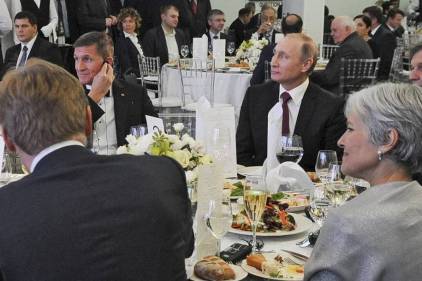
One was Michael Flynn, who would briefly serve as Donald Trump’s national security adviser and who, according to the Times, “was paid $45,000 by the Russian government’s media arm for a 2015 speech and dined at the arm of the Russian president, Vladimir V. Putin.” Another was Paul Manafort, who briefly served as Trump’s campaign chairman and was a source of concern because he had “lobbied for pro-Russia interests in Ukraine and worked with an associate who has been identified as having connections to Russian intelligence.” A third was Carter Page, a Trump foreign-policy adviser who “was well known to the FBI” because “[h]e had previously been recruited by Russian spies and was suspected of meeting one in Moscow during the campaign.”
The fourth was George Papadopoulos, a “young and inexperienced campaign aide whose wine-fueled conversation with the Australian ambassador set off the investigation. Before hacked Democratic emails appeared online, he had seemed to know that Russia had political dirt on Mrs. Clinton.”
Seems incriminating, eh? But in each case the connection was more tenuous than the Times lets on. Flynn, for example, didn’t dine “at the arm of the Russian president” at a now-famous December 2015 Moscow banquet honoring the Russian media outlet RT. He was merely at a table at which Putin happened to sit down for “maybe five minutes, maybe twenty, tops,” according to Green Party presidential candidate Jill Stein who was just a few chairs away. No words were exchanged, Stein says, and “[n]obody introduced anybody to anybody. There was no translator. The Russians spoke Russian. The four people who spoke English spoke English.”
The Manafort associate with the supposed Russian intelligence links turns out to be a Russian-Ukrainian translator named Konstantin Kilimnik who studied English at a Soviet military school and who vehemently denies any such connection. It seems that the Ukrainian authorities did investigate the allegations at one point but declined to press charges. So the connection is unproven.
Page Was No Spy

Page: No spy.
The same goes for Carter Page, who was not “recruited” by Russian intelligence, but, rather, approached by what he thought were Russian trade representatives at a January 2013 energy symposium in New York. When the FBI informed him five or six months later that it believed the men were intelligence agents, Page appears to have cooperated fully based on a federal indictment filed with the Southern District of New York. Thus, Page was not a spy pace the Times, but a government informant as ex-federal prosecutor Andrew C. McCarthy has pointed out – in other words, a good guy, as the Times would undoubtedly see it, helping the catch a couple of baddies.
As for Papadopoulos, who the Times suggests somehow got advance word that WikiLeaks was about to dump a treasure trove of Hillary Clinton emails, the article fails to mention that at the time the conversation with the Australian ambassador took place, the Clinton communications in the news were the 30,000 State Department emails that she had improperly stored on her private computer. These were the emails that “the American people are sick and tired of hearing about,” as Bernie Sanders put it. Instead of spilling the beans about a data breach yet to come, it’s more likely that Papadopoulos was referring to emails that were already in the news – a possibility the Times fails to discuss.
FBI ‘Perplexed’
One could go on. But not only does the Times article get the details wrong, it paints the big picture in misleading tones as well. It says that the FBI was “perplexed” by such Trump antics as calling on Russia to release still more Clinton emails after WikiLeaks went public with its disclosure. The word suggests a disinterested observer who can’t figure out what’s going on. But it ignores how poisonous the atmosphere had become by that point and how everyone’s mind was seemingly made up.
By July 2016, Clinton was striking out at Trump at every opportunity about his Russian ties – not because they were true, but because a candidate who had struggled to come up with a winning slogan had at last come across an issue that seemed to resonate with her fan base. Consequently, an intelligence report that Russia was responsible for hacking the Democratic National Committee “was a godsend,” wrote Jonathan Allen and Amie Parnes in Shattered, their best-selling account of the Clinton campaign, because it was “hard evidence upon which Hillary could start to really build the case that Trump was actually in league with Moscow.”
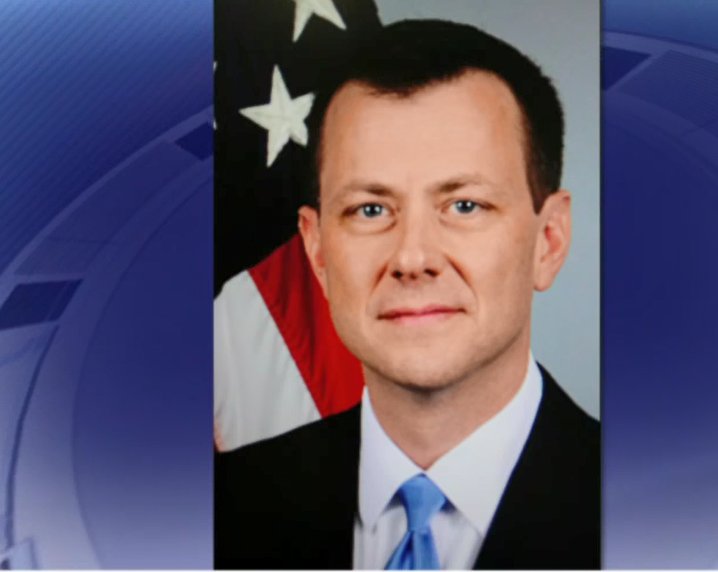
Not only did Clinton believe this, but her followers did as well, as did the corporate media and, evidently, the FBI. This is the takeaway from text messages that FBI counterintelligence chief Peter Strzok exchanged with FBI staff attorney Lisa Page.
Andrew McCarthy, who has done a masterful job of reconstructing the sequence, notes that in late July 2016, Page mentioned an article she had come across on a liberal web site discussing Trump’s alleged Russia ties. Strzok texted back that he’s “partial to any women sending articles about nasty the Russians are.” Page replied that the Russians “are probably the worst. Very little I finding redeeming about this. Even in history. Couple of good writers and artists I guess.” Strzok heartily agreed: “f***ing conniving cheating savages. At statecraft, athletics, you name it. I’m glad I’m on Team USA.”
Strzok: Thought F’ing Russians ‘nasty’
The F’ing Russian ‘Savages’
This is the institutional bias that the Times doesn’t dare mention. An agency whose top officials believe that “f***ing conniving cheating savages” are breaking down the door is one that is fairly guaranteed to construe evidence in the most negative, anti-Russian way possible while ignoring anything to the contrary. So what if Carter Page had cooperated with the FBI? What’s important is that he had had contact with Russian intelligence at all, which was enough to render him suspicious in the bureau’s eyes. Ditto Konstantin Kilimnik. So what if the Ukrainian authorities had declined to press charges? The fact that they had even looked was damning enough.
The FBI thus made the classic methodological error of allowing its investigation to be contaminated by its preconceived beliefs. Objectivity fell by the wayside. The Times says that Christopher Steele, the ex-MI6 agent whose infamous, DNC and Clinton camp paid-for opposition research dossier turned “golden showers” into a household term, struck the FBI as “highly credible” because he had “helped agents unravel complicated cases” in the past. Perhaps. But the real reason is that he told agents what they wanted to hear, which is that the “Russian regime has been cultivating, supporting and assisting TRUMP for at least 5 years” with the “[a]im, endorsed by PUTIN, … [of] encourage[ing] splits and divisions in [the] western alliance” (which can be construed as a shrewd defensive move against a Western alliance massing troops on Russian borders.)
What else would one expect of people as “nasty” as these? In fact, the Steele dossier should have caused alarm bells to go off. How could Putin have possibly known five years before that Trump would be a viable presidential candidate? Why would high-level Kremlin officials share inside information with an ex-intelligence official thousands of miles away? Why would the dossier declare on one page that the Kremlin has offered Trump “various lucrative real estate development business deals” but then say on another that Trump’s efforts to drum up business had gone nowhere and that he therefore “had had to settle for the use of extensive sexual services there from local prostitutes rather than business success”? Given that the dossier was little more than “oppo research” commissioned and funded by the Democratic National Committee and the Clinton campaign, why was it worthy of consideration at all?
The Rush to Believe
But all such questions disappeared amid the general rush to believe. The Times is right that the FBI slow-walked the investigation until Election Day. This is because agents assumed that Trump would lose and that therefore there was no need to rush. But when he didn’t, the mood turned to one of panic and fury.
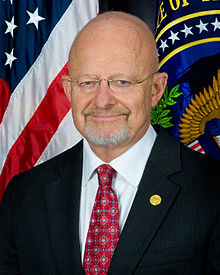
Without offering a shred of evidence, the FBI, CIA, NSA, and Director of National Intelligence James Clapper issued a formal assessment on Jan. 6, 2017, that “Putin ordered an influence campaign in 2016 aimed at the US presidential election … [in order] to undermine public faith in the US democratic process, denigrate Secretary Clinton, and harm her electability and potential presidency.” The “assessment” contains this disclaimer: “
Clapper: Bogus ‘assessment’
The New Yorker reports that an ex-aide to John McCain hoped to persuade the senator to use the Steele dossier to force Trump to resign even before taking office. (The ex-aide denies that this was the case.)
When FBI Director James Comey personally confronted Trump with news of the dossier two weeks prior to inauguration, the Times says he “feared making this conversation a ‘J. Edgar Hoover-type situation,’ with the FBI presenting embarrassing information “to lord over a president-elect.”
But that is precisely what happened. When someone – most likely CIA Director John Brennan, now a commentator with NBC News – leaked word of the meeting and Buzzfeed published the dossier four days later, the corporate media went wild. Trump was gravely wounded, while Adam Schiff, Democratic point man on the House Intelligence Committee, would subsequently trumpet the Steele dossier as the unvarnished truth. According to the Times account, Trump was unpersuaded by Comey’s assurances that he was there to help. “Hours earlier,” the paper says, “…he debuted what would quickly become a favorite phrase: ‘This is a political witch hunt.’”
The Times clearly regards the idea as preposterous on its face. But while Trump is wrong about many things, on this one subject he happens to be right. The press, the intelligence community, and the Democrats have all gone off the deep end in search of a Russia connection that doesn’t exist. They misled their readers, they made fools of themselves, and they committed a crime against journalism. And now they’re trying to dodge the blame.
Daniel Lazare is the author of The Frozen Republic: How the Constitution Is Paralyzing Democracy (Harcourt Brace, 1996) and other books about American politics. He has written for a wide variety of publications from The Nation to Le Monde Diplomatique, and his articles about the Middle East, terrorism, Eastern Europe, and other topics appear regularly on such websites as Jacobin and The American Conservative.